
SynthDriveEval
Master's thesis — VITA Lab, EPFL
TL;DR
Vision–Language Models are increasingly used as judges of synthetic driving videos, but the best open VLMs score below 40% on edge-case driving questions — and Qwen3-VL alone reaches only 21%. I built SynthDriveEval, a benchmark of 1,597 synthetic clips and 7,371 expert-annotated questions, plus a training-free tool-augmented agent that grounds the VLM in optical flow (RAFT), instance segmentation (SAM 3), and a frequency-domain generation detector. The agent reaches 60.1% overall accuracy — nearly tripling its own backbone and beating the strongest baseline by +20 pp.
Why this matters
A growing body of research proposes Vision–Language Models as components of autonomous-driving pipelines — from VLM-RL[1], which turns a pre-trained VLM into a reward signal for safe-driving reinforcement learning, to DriveLLM-V[2], an explainable end-to-end framework that fuses vision and language to support interpretable driving decisions. In parallel, simulation itself is shifting from physics engines to generative world models — systems like GEM[3] and NVIDIA's Cosmos family that synthesise realistic driving rollouts conditioned on scene context and prompts. This matters precisely because the hard cases — running a red light, aggressive overtakes, failure to stop — are the ones we cannot safely film on real roads, so we have to generate them.
These two trajectories collide on a specific question: if we use a VLM to audit what a generative simulator produces — to screen synthetic datasets, rank world models, or provide feedback during training — can we trust its judgement? “Good driving” is temporal, context-dependent, and hard to reduce to explicit metrics (a form of Polanyi's paradox for driving behaviour). My thesis answers the question empirically: no, not reliably — off-the-shelf VLMs exhibit systematic biases on synthetic driving footage. And it proposes a way to fix it without retraining.
The benchmark
SynthDriveEval is built on two NVIDIA Cosmos generators with very different characters. Cosmos-Drive-Dreams[4] produces high-fidelity clips conditioned on HD maps and natural-language prompts — perfect for staging traffic violations that would be unsafe or impossible to film. I rewrite each prompt across 8 weather and time-of-day variants, then manually filter the outputs because the generator silently rewrites road layouts when it can't satisfy the prompt.
Cosmos-Predict1[5], by contrast, is a lower-fidelity general-purpose video generator conditioned on a single image plus a text prompt. Its weaker fidelity surfaces morphing, warping, and pop-in artifacts — exactly what we need to stress-test artifact perception. The conditioning frames are real dashcam shots[6], weather-augmented with Qwen-Image-Edit[7], then manually pruned of cartoon-like outputs.
Each curated clip is paired with one or more questions drawn from a six-category taxonomy designed to probe complementary VLM capabilities — from binary “is this real?” calls to fine-grained spatio-temporal reasoning.
How VLMs fail on driving video
Across six open-source VLMs and GPT-5.4-mini, accuracy ranges from 10% to 39% — but the failure profile is more interesting than the numbers. The same biases recur across models:
- Always-Real bias. Across the benchmark, every model answers “Real” on the vast majority of reality-check items — bare Qwen3-VL does so on more than 96% of them — even though every clip in SynthDriveEval is generated.
- Compliance hallucinated from static cues. On clips where the ego car visibly crosses a red light, VLMs will confidently state that the ego car “stopped because the traffic light was red” — inferring compliance from the presence of the traffic light rather than observing what actually happened.
- Midpoint-anchored Likert collapse (GPT-5.4-mini). When asked to rate the safety of a video on a scale from 1 to 3 (1 being unsafe and 3 totally safe), GPT-5.4-mini never emits a “1” across 1,061 items: its output distribution is {2 : 964, 3 : 97}, so every ground-truth-1 clip is automatically wrong. The realism Likert never under-rates.
- Perception–labelling disconnect on overtakes. For GPT-5.4-mini, 91.7% of ground-truth-Right overtake failures are answered “Left”, even when the model correctly describes ego-relative positions in its free-text reasoning. The error lives at the labelling step, not in perception.
A training-free tool-augmented agent
These failures point to an imbalance in the data they were trained on. The driving corpora were very likely overwhelmingly compliant: cars stop at red lights, overtakes happen on the left, drivers obey stop signs. With vanishingly few counter-examples during training, a VLM ends up learning scene statistics rather than behaviour, and at inference time it defaults to whatever the training distribution says. Fine-tuning on targeted negatives would plausibly close the gap — but collecting and annotating enough edge-case footage to train on is slow and expensive.
I take a training-free route instead. I pick Qwen3-VL[8] as the backbone — a widely-used reference open VLM that natively supports tool-calling — and wrap it in an agent harness with three tools, each targeting one of the failure modes. The VLM keeps its general semantic capability; the tools inject the evidences it was lacking.
1. Optical flow with RAFT[9] — for motion grounding
Many driving questions hinge on motion cues the VLM doesn't track. RAFT computes per-pixel optical flow that Qwen3-VL can actually reason over.
2. SAM 3[10] crop-and-zoom — for localized inspection
Many artifacts are subtle at native scale for a VLM: texture drift on a distant vehicle, a pedestrian outline morphing across frames, garbled sign text. SAM 3 lets the agent request open-vocabulary instance masks (“cars”, “pedestrians”, “traffic signs”); each instance is cropped and upsampled so the target object dominates the VLM's view.
3. FFT directional anisotropy — for provenance
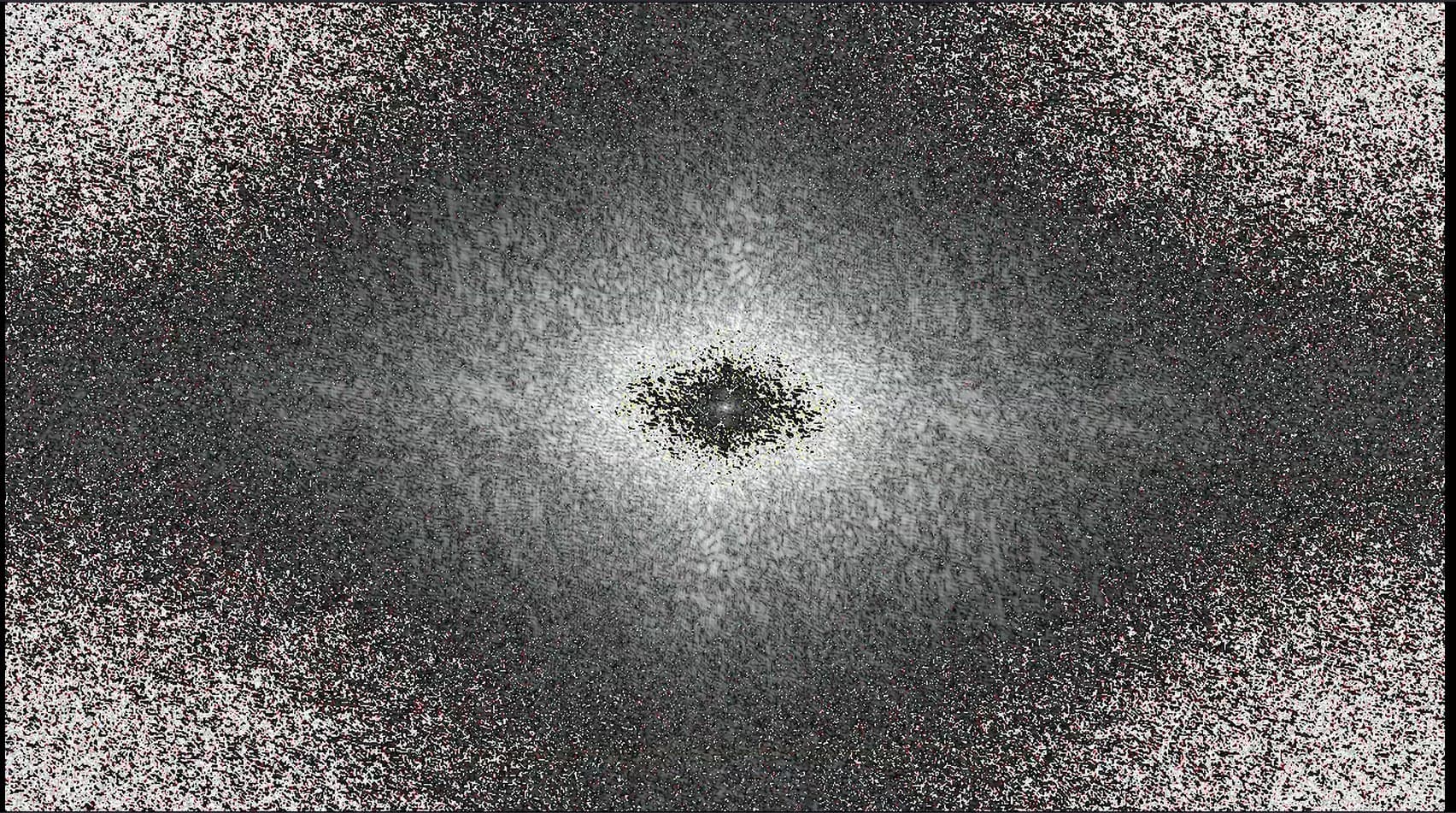
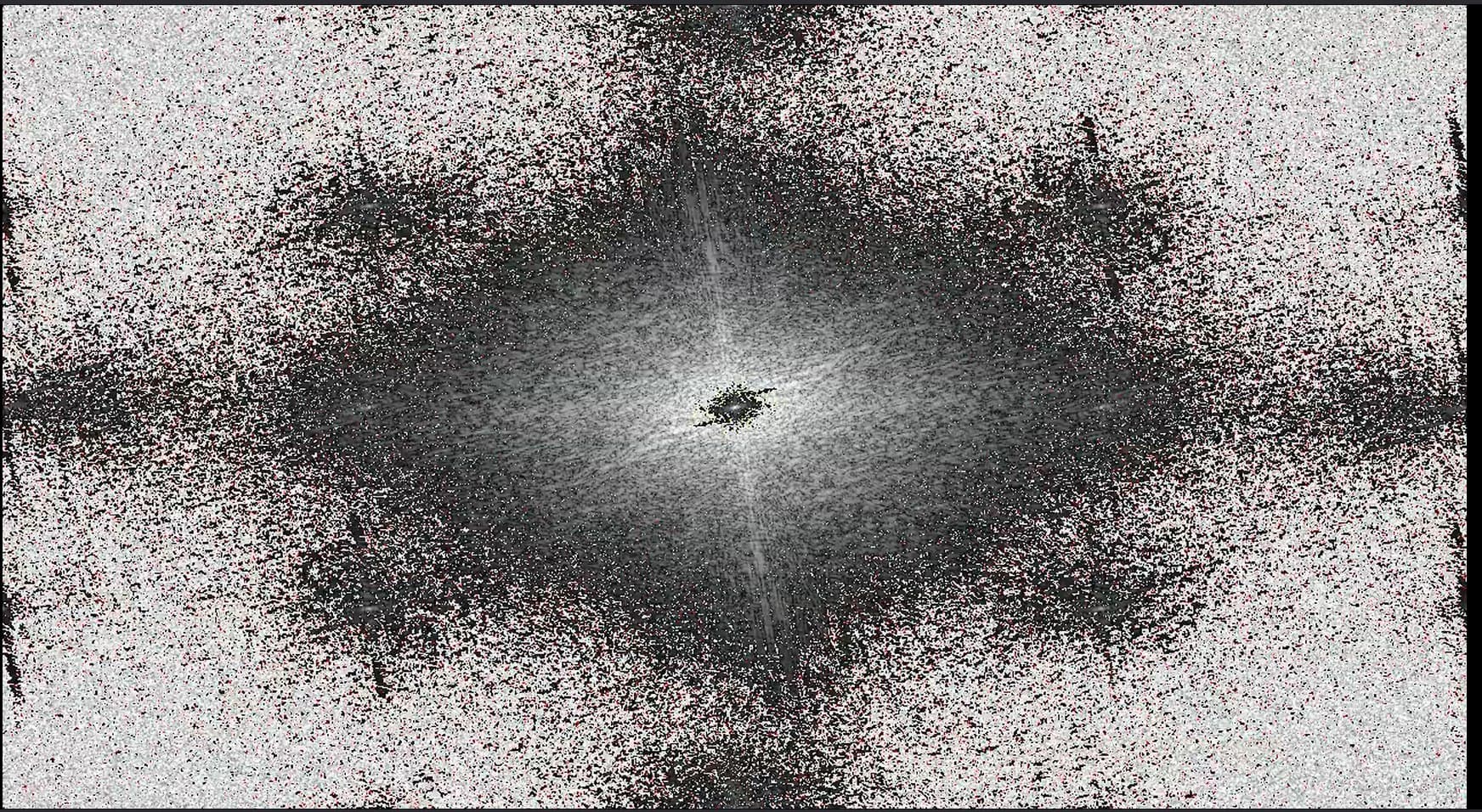
Optical flow and segmentation give no signal on “is this real or generated?”. So I built a frequency-domain detector: for each frame, the tool computes the 2D FFT magnitude spectrum, defines a high-frequency annular ring (30–90% of Nyquist), sweeps 72 angular bins, and returns the coefficient of variation of energy across bins — a directional anisotropy score. Real footage shows smooth elliptical falloff (~0.040); AI-generated clips show bright cross-shaped streaks and directional concentration (~0.055). A 0.048 threshold, calibrated on 36 validation videos, separates the two regimes.
Results
Across all six categories, the tool-augmented agent reaches 60.1% overall accuracy, almost tripling its own Qwen3-VL baseline (21%) and beating the strongest base VLM by over 20 pp. The largest gains come exactly where the tools target failure modes: +54 pp on reality detection (FFT) and +43 pp on artifact recognition (SAM crops).
Release
The full benchmark is publicly available on Hugging Face. The agent code is currently a private repository and will be released alongside the paper. The arXiv preprint will be linked here as soon as it's online.
References
- [1] Z. Huang et al. (2025). VLM-RL: A unified vision language models and reinforcement learning framework for safe autonomous driving. Transportation Research Part C: Emerging Technologies 180, 105321.
- [2] J. Hou et al. (2025). An explainable end-to-end autonomous driving framework based on large language model and vision modality fusion: design and application of DriveLLM-V. Transportation Research Part C: Emerging Technologies 181, 105368.
- [3] M. Hassan et al. (2024). GEM: A Generalizable Ego-Vision Multimodal World Model for Fine-Grained Ego-Motion, Object Dynamics, and Scene Composition Control. arXiv:2412.11198.
- [4] X. Ren et al. (2025). Cosmos-Drive-Dreams: Scalable Synthetic Driving Data Generation with World Foundation Models. arXiv:2506.09042.
- [5] N. Agarwal et al. (2025). Cosmos World Foundation Model Platform for Physical AI. arXiv:2501.03575.
- [6] W. Bao, Q. Yu, Y. Kong (2020). Uncertainty-based Traffic Accident Anticipation with Spatio-Temporal Relational Learning. ACM Multimedia Conference.
- [7] Alibaba (2025). Qwen-Image-Edit: Image Editing with Higher Quality and Efficiency. Online.
- [8] S. Bai et al. (2025). Qwen3-VL Technical Report. arXiv:2511.21631.
- [9] Z. Teed, J. Deng (2020). RAFT: Recurrent All-Pairs Field Transforms for Optical Flow. arXiv:2003.12039.
- [10] N. Carion et al. (2025). SAM 3: Segment Anything with Concepts. arXiv:2511.16719.
- [11] A. Azzolini et al. (2025). Cosmos-Reason1: From Physical Common Sense To Embodied Reasoning. arXiv:2503.15558.
- [12] É. Beauchamp, N. Saunier, M. Cloutier (2022). Study of automated shuttle interactions in city traffic using surrogate measures of safety. Transportation Research Part C: Emerging Technologies 135, 103465.
- [13] H. Cheng et al. (2025). Emergency Index (EI): A two-dimensional surrogate safety measure considering vehicles' interaction depth. Transportation Research Part C: Emerging Technologies, 104981.
- [14] Z. Huang et al. (2024). VLM-RL: A Unified Vision Language Models and Reinforcement Learning Framework for Safe Autonomous Driving. arXiv:2412.15544.
- [15] D. Li et al. (2025). Aria: An Open Multimodal Native Mixture-of-Experts Model. arXiv:2410.05993.
- [16] B. Li et al. (2024). LLaVA-OneVision: Easy Visual Task Transfer. arXiv:2408.03326.
- [17] M. Liu, W. Zhang (2025). Is Your Video Language Model a Reliable Judge?. arXiv:2503.05977.
- [18] Y. Ma et al. (2024). Evolving testing scenario generation and intelligence evaluation for automated vehicles. Transportation Research Part C: Emerging Technologies 163, 104620.
- [19] S. Motamed et al. (2025). TRAVL: A Recipe for Making Video-Language Models Better Judges of Physics Implausibility. arXiv:2510.07550.
- [20] R. Qian et al. (2022). Multimodal Open-Vocabulary Video Classification via Pre-Trained Vision and Language Models. arXiv:2207.07646.
- [21] Y. Qu et al. (2025). VL-SAFE: Vision-Language Guided Safety-Aware Reinforcement Learning with World Models for Autonomous Driving. arXiv:2505.16377.
- [22] K. Ren et al. (2025). Intelligent testing environment generation for autonomous vehicles with implicit distributions of traffic behaviors. Transportation Research Part C: Emerging Technologies 174, 105106.
- [23] W. Wang et al. (2025). InternVL3.5: Advancing Open-Source Multimodal Models in Versatility, Reasoning, and Efficiency. arXiv:2508.18265.
- [24] Wayve (2025). GAIA-3: Scaling World Models to Power Safety and Evaluation. Online.
- [25] S. Xie et al. (2025). Are VLMs Ready for Autonomous Driving? An Empirical Study from the Reliability, Data, and Metric Perspectives. arXiv:2501.04003.
- [26] J. Xu et al. (2025). Qwen3-Omni Technical Report. arXiv:2509.17765.
- [27] R. Yu, X. Ma, X. Wang (2025). Introducing Visual Perception Token into Multimodal Large Language Model. arXiv:2502.17425.
- [28] G. Zhao et al. (2025). DriveDreamer-2: LLM-Enhanced World Models for Diverse Driving Video Generation. Proceedings of the AAAI Conference on Artificial Intelligence.
- [29] Y. Zhou et al. (2026). DrivingGen: A Comprehensive Benchmark for Generative Video World Models in Autonomous Driving. arXiv preprint arXiv:2601.01528.